en
en Български
SubTotal: 0.00 BGN
This site uses cookies to help give you the best possible user experience. By continuing to browse this site you give consent for cookies to be used!
+359 2 9793413
sales@aph.bas.bg

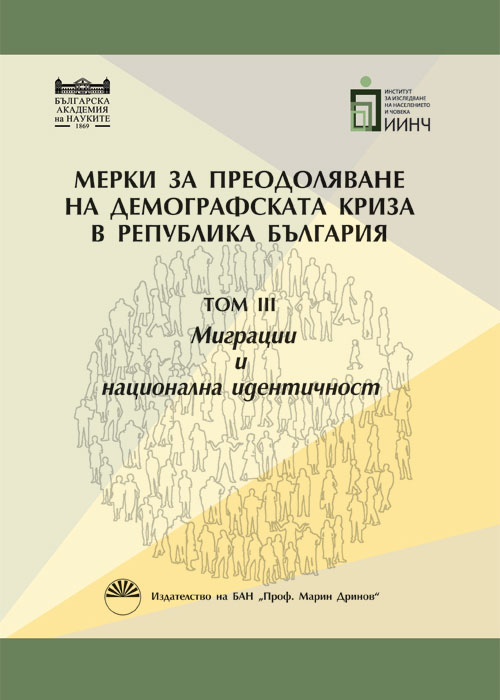
Мерки за преодоляване на демографската криза, Том ІІІ
Миграции и национална идентичност
Irena Zareva, Veselin Minchev, K. Vladimirova, I. Kalchev, A. Nakova, I. Ilieva, V. Ganeva-Raicheva, M. Maeva, S. Tashev, S. Kalcheva, E. Aleksandrova, I. Erolova, P. Stoyanova
Summary
About The Authors
- • Irena Zareva
 Assoc. Prof. Dr. Irena Zareva works at the Institute for Economic Research at the Bulgarian Academy of Sciences, Macroeconomics Section. Her scientific publications are in the following areas: human capital - condition, formation, use, development policies, economic aspects of education and training, educational policy, human resources, labor market, demand and supply of labor in educational and qualification plan. She has participated in a number of research and applied projects funded by state and international institutions and programs.
- • Veselin Minchev
- • K. Vladimirova
- • I. Kalchev
- • A. Nakova
- • I. Ilieva
- • V. Ganeva-Raicheva
- • M. Maeva
- • S. Tashev
- • S. Kalcheva
- • E. Aleksandrova
- • I. Erolova
- • P. Stoyanova
Specifications
Recently Viewed е-Books