en
en Български

SubTotal: 00.00 BGN
This site uses cookies to help give you the best possible user experience. By continuing to browse this site you give consent for cookies to be used!
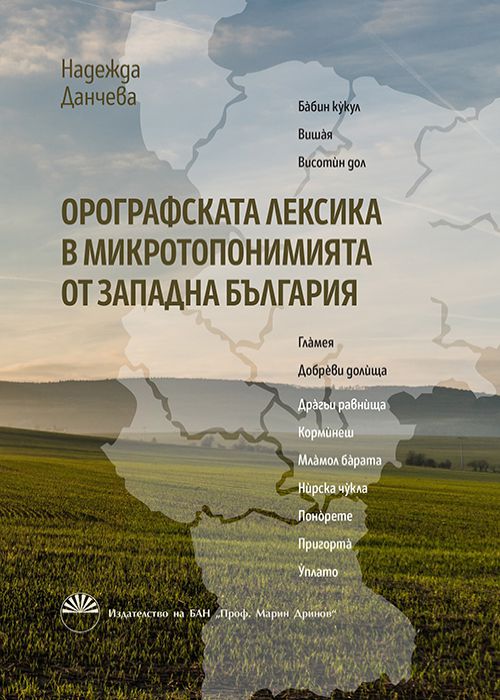
Orographic vocabulary in Bulgarian microtoponymy from Western Bulgaria
Nadejda Dancheva
Summary
The object of study in the book are the names of relief forms, or the so-called orographic vocabulary, which is preserved in microtoponyms from Western Bulgaria.
The orographic vocabulary is excerpted from nearly 100,000 toponyms registered in the former districts of the territory of Western Bulgaria within its modern borders. In order to outline the main processes in the lexical system under consideration, about 17,000 microtoponyms and 800 geographical appellations with their participation are analyzed. Special attention is paid to orographic terms and geographical microtoponyms that arose as a result of metaphorical transfer.
The study applies the etymological, genetic, areal method, structural and comparative analysis, as well as the onomasiological and semasiological approach. The work clarifies what names are used to name the same geographical object, and for this purpose the corpus of lexemes is divided into two main thematic groups: Designations for convex landforms and their elements and Designations for concave landforms and their elements. Through the semasiological approach, the system of meanings characteristic of geographical terminology in the composition of microtoponymy is established.
The book describes in detail the lexical features of orographic vocabulary and traces its toponymizing activity in the microtoponymy of the studied area.
The outlined corpus of geographical appellations should be used to supplement the contemporary and historical lexical foundations reconstructed from toponyms, and the conclusions reached in the study will help to establish a significant part of the lexical, structural and word-formation features of Bulgarian microtoponymy.
The orographic vocabulary is excerpted from nearly 100,000 toponyms registered in the former districts of the territory of Western Bulgaria within its modern borders. In order to outline the main processes in the lexical system under consideration, about 17,000 microtoponyms and 800 geographical appellations with their participation are analyzed. Special attention is paid to orographic terms and geographical microtoponyms that arose as a result of metaphorical transfer.
The study applies the etymological, genetic, areal method, structural and comparative analysis, as well as the onomasiological and semasiological approach. The work clarifies what names are used to name the same geographical object, and for this purpose the corpus of lexemes is divided into two main thematic groups: Designations for convex landforms and their elements and Designations for concave landforms and their elements. Through the semasiological approach, the system of meanings characteristic of geographical terminology in the composition of microtoponymy is established.
The book describes in detail the lexical features of orographic vocabulary and traces its toponymizing activity in the microtoponymy of the studied area.
The outlined corpus of geographical appellations should be used to supplement the contemporary and historical lexical foundations reconstructed from toponyms, and the conclusions reached in the study will help to establish a significant part of the lexical, structural and word-formation features of Bulgarian microtoponymy.
Аbout The Author
Specifications
ISBN: 978-619-245-089-2
DOI: n/a
Year of Publication: 2020
Category: Linguistics
Language: Bulgarian
Recently Viewed е-Books